About Me

My photo
Approved instructor for Retired P. O.& LEOSA .Pa & NJ Approved instructor for NJ CCW. Also approved instructor for the following states non-resident CCW De, Fl, & Md. Retired Deputy Conservation Officer, N. J. Division of Fish & Wildlife, Bureau of Law Enforcement. Certified Law Enforcement Firearms Instructor; Handgun, Shotgun, Patrol Rifle, Certified Tactical Shooting Instructor, & RSO with over 25 years of experience. Certified by N.J.Police Training Commission, NRA Law Enforcement Division,& NRA Civilian Instructor Division. For information regarding Training Courses, Contact me @ 215 416 0750 or e-mail me @ rotac2@gmail.com

Sunday, January 27, 2019

Hi folks, sorry that I haven't been posting anything lately.  I just have not been in a very great mood lately.  I am having a difficult time understanding what the hell is going on in our great nation.  In addition, being a resident of the socialist state of NJ it compounds my disbelieve that we are still citizens governed by of The Constitution of The United States of America.  If we are not careful we are going to lose our great country.  Well enough of that for now.  

Attached is a good article on the new Glock Slimlines.  Thanks Rich Grassi, Tactical Wire

January 15 : 2019  
GLOCK Slimlines Accuracy and Handling Tests
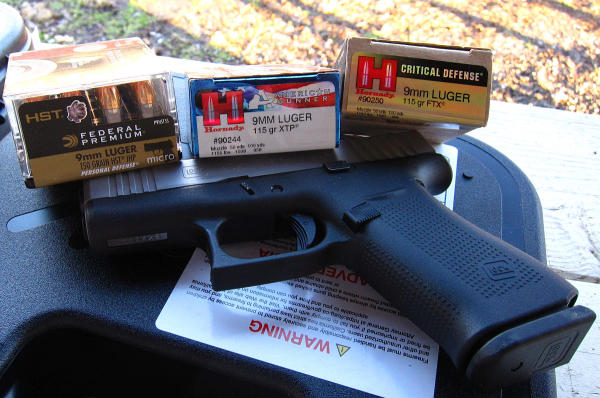
Due to the uncharacteristically wet season, the range was a mess. I was able to do accuracy work with the little GLOCK Slimline pistols. I limited the initial exam to two loads per gun as I was rushed.
Shooting from the bench at 25 yards, I found that the guns will, at their best, shoot into around two inches at 25 yards. This assumes a properly secured machine rest. In human hands, expect 3 – 4 inch groups at the same distance.
The following results were recorded:
G43X
Federal “Micro” 150 gr. HST5”3 1/3”Vertical stringing (grip)
Hornady Critical Defense 115 gr.5”2 ¼”Strike 4 ¾” low at 25 yards
G48
Super Vel 115 gr. Solid Copper HP +P4”3 ½”
American Gunner 115 gr.3”1 ¾”
Vertical stringing tells me that my grip is inconsistent. I don’t see that as a regular issue with either gun, but happened intermittently for me. I’m thinking I need more friction -- perhaps Talon Grip will release a G43x-G48 version of their carry-appropriate grip “tape.”
As to the low point of impact, it’s apparent that both guns shoot to the “dot,” not to the top edge of the front sight. Holding intentionally high gave a good elevation but I was tending left at least some of the time. Add the inconsistency of my grip to my natural tendency to push left and we have the windage issue. Legendary Lawman “Marshal” Chuck Haggard has since tried to coach me on this issue and we’ll see how that plays out in future range trips.
As to the ammunition, the Hornady American Gunner load continues to surprise me. It’s very consistent and very accurate as well as being a ‘value priced’ offering.
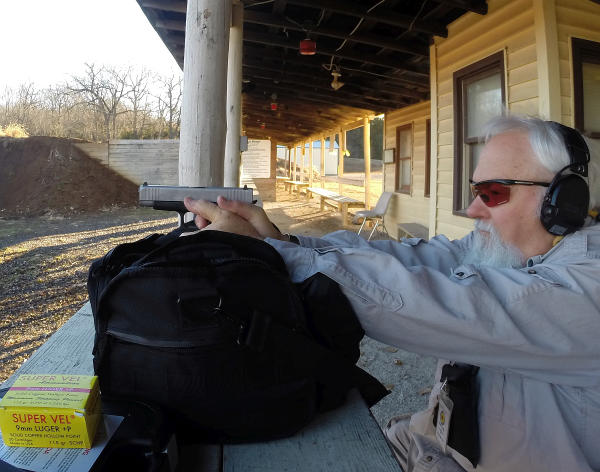
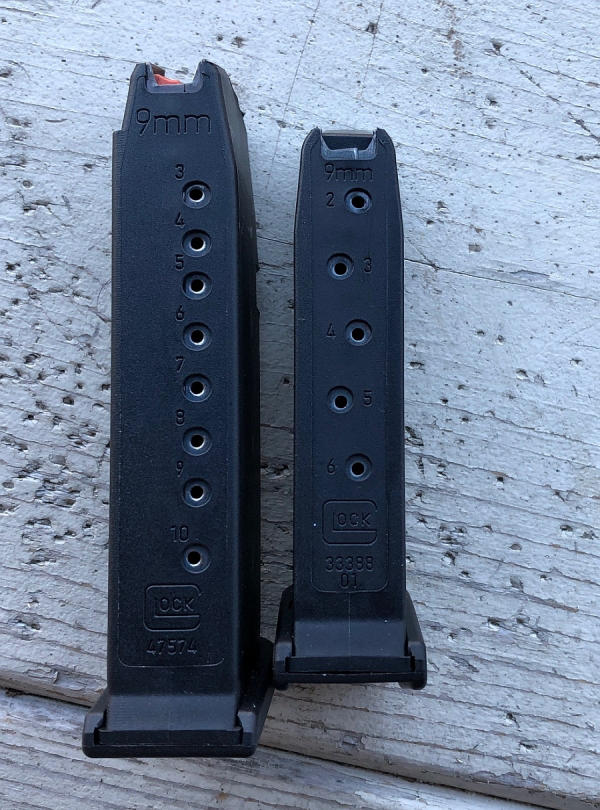
Using a hasty rest at the bench on 25 yard targets, a pair of loads was tried from each gun. Below, the G43 magazine is a great deal thinner than the G43X/G48 magazine -- to keep the magazine from being longer while still giving a 10-round capacity.
During a morning when the range deck was frozen, keeping me from having to trudge through a bog, I shot the comparative standards with each gun as well as the ‘abbreviated Feeb’ (my fifty-round version of the current FBI qual) and practice drills with the guns. I found I did “okay” with the GLOCK 48 using Federal “Aluminum” practice ammo. It was a complete BOLO with the G43X and the aforementioned Hornady American Gunner load. I could cry about the cold temps, digging the gun out from under layers of clothing, the eight weeks since I’d fired that course, or any number of other issues, but these are the things one should expect when facing the event you least want to face.
That makes it a good test.
The G48 was at least under 40 seconds cumulatively – only slightly. Only two guns were slower for me before this experience. With the GLOCK 43X, the time was bad enough before the five seconds added for penalties – a real record for me on this course of fire.
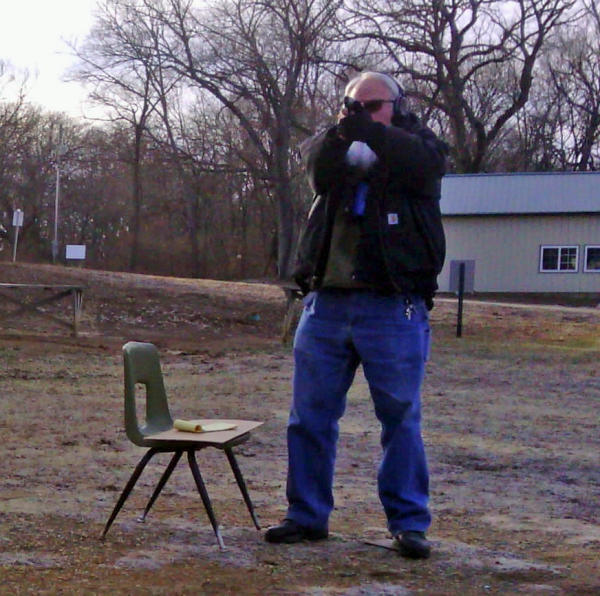
Layers of clothing hampers the draw -- and reholstering. Below, the 5-yard, 1-hole effort with the G48 using Winchester "White Box" didn't create a 5-shot 1-hole group -- but it wasn't bad.
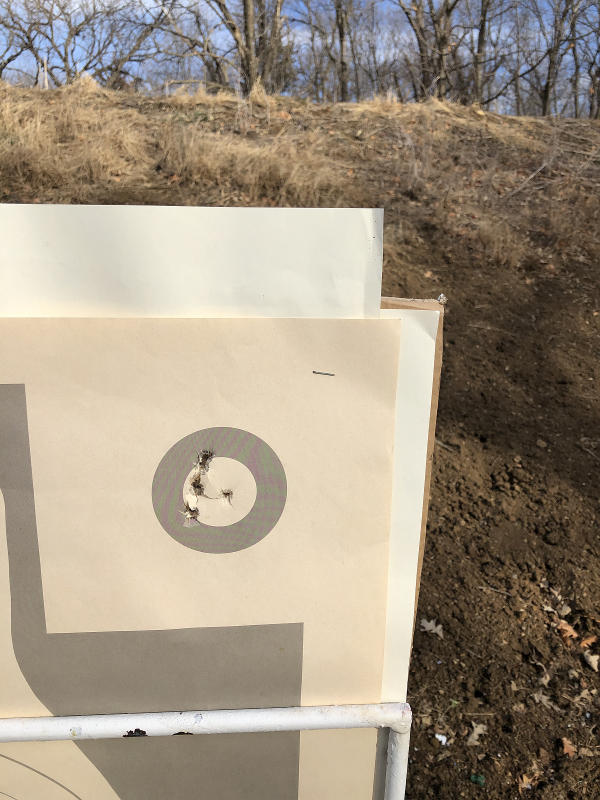
Aside from the layers of clothing – something that would affect any gun on this kind of evaluation – the thinner frames of these samples were harder for me to index than the typical ‘fat’ frame of the standard GLOCK 9mm pistol. That’s not something I expected, as the non-double stack guns were always better for me before I went with G19 as the regular carry piece in 2001. I found I needed more ‘grip’ on the guns too.
Doing the abbreviated Feeb on the QIT-99 target with the G43X ended with two down, on the left. That wasn’t terrible, but it’s a course I normally clean with about anything. I used 124 grain FMJ loads from Black Hills Ammunition for this course.
Using Winchester “White Box” 115 grain FMJ and the IALEFI-Q target with the GLOCK 48, I shot singles, pairs, singles from guard, a pair of five-shot strings at 25 yards and the ‘one-hole’ drill from five yards. There were three hits outside the ‘rings’ at 7 o’clock, and all but two in the rings were in the “x.” I felt a little better.
While the “one-hole” at five yards wasn’t, both five-round strings were tight.
These are new guns, a new form-factor for GLOCK. I didn’t expect sterling results from the start – but it’s nice when that happens. I’ll continue my work with them and keep you posted.
- - Rich Grassi
© Copyright 2019 The Tactical Wire. All Right

Thursday, October 4, 2018

Skill Set: Working the Fundamentals

Skill Set: Working the Fundamentals
You attend training to learn defensive tactics and principles. Next comes practice, learning through repetition and acquiring the ability to apply these skills on demand and in defense of life. Going to the range to practice marksmanship is a worthy endeavor, but only one part of the “big” picture. You have to work on the fundamentals of the threat response: moving, communicating, using cover and shooting if necessary. During this practice you’re also developing the mental abilities to solve a defensive problem.
Moving is an immediate response to danger, whether you’re armed or not. (Remember that “unarmed” is a state of mind; there are always weapons available, even if that’s not the intended purpose of the item.) Moving gets you out of harm’s way. Escape or avoid the danger. You move to cover and the protection it offers. There are bystanders or family between you and the threat – moving creates a clear angle of attack. The threat is trying to hit/cut/shoot you. Moving makes it more difficult. Shooting while moving is definitely a skill that must be practiced.
You communicate with the threat. “Stop! Leave my house!” They may comply. Communication is required with family or friends. You tell them where to go or what to do. Communication connects you with an armed partner, coordinating tactics. Communicating under stress doesn’t come natural. Like any skill it requires practice.
There is very little “natural” about using cover. The first principle is to maintain distance between you and the object you’re using for protection. Distance prevents you from catching debris and fragmentation if bullets are hitting the hard surface you’re behind. Keeping some distance from cover lets you see more of the environment on the other side of cover, and puts more ground between you and the treat. You have to learn how to position your body to expose the least amount of your body necessary to locate, identify and if necessary engage the threat. It takes work to get this right.
Finally, we get to the “shooting.” Marksmanship is mandatory; shooting tight groups is good. But bulls-eye shooting is different from defensive marksmanship. You learn where to place your hits on the threat to stop them as efficiently as possible. Ultimately some form of reactive target must be used. Something that requires varying hits in different zones to get the “stop.” You work on close large targets, and smaller targets at longer distances. You learn what you can hit, and how fast or slow you have to fire to hit.
The only way to learn these skills – again: moving, communication, using cover and defensive shooting – is practice. These are not instinctual or natural. Instinct tells you to hug in tight and close to cover, which is not where you want to be. It’s natural to focus on the threat while shooting as opposed to the front sight. Instinct tells you to root to the ground when fighting; we want to be moving. The only way to learn the required skills is through practice. At the same time you’re overriding the instinctual part of the brain that’s screaming at you to do the wrong thing.
The best way to learn defensive skills, and to improve, is dry practice. With a dummy pistol you practice drawing, moving, communicating and using cover, working towards the thousands of repetitions required to learn and apply a complicated sequence of actions. For many, dry practice is the only way to develop these skills. A lot of “firing” ranges don’t allow you to draw from the holster, move, use cover or fire multiple shots quickly. With a dummy weapon you can safely practice at home, any time.
The next time you’re thinking about going to the range to burn some ammo consider staying home and working on your tactics for that time. Yes, shooting is good, but it’s nowhere near all you need to know. Put in some hard work, so when the time comes you’re assured of being ready.
Tiger McKee is director of Shootrite Firearms Academy

Tuesday, September 11, 2018

Thursday, September 6, 2018

Skill Set: Handgun Use, Then and Now

Skill Set: Handgun Use, Then and Now
I have a large collection of books on the use of firearms. The other day I started counting, but stopped at 400 – not including books about psychology and such which are related to the use of firearms and teaching, but not specifically so. The oldest work I have is “The Pistol As A Weapon Of Defence In The House And On The Road,” published in 1875. The author is unknown, and I haven’t been able to find out any history on it; Jeff Cooper – who we all know – wrote the forward to the copy I have which was published in 2004 by Paladin Press.
This work was written when handguns were still evolving. Colt had just introduced their Single Action Army – the “Peacemaker” – and the Model 3 was Smith & Wesson’s latest offering. The double action revolver was still several years down the road. However, handguns were becoming extremely popular, yet the author reports that they were still seen as “… either a toy or as the weapon of the desperado.” This work attempts to correct that attitude and focuses on personal use of the pistol for self-defense. In the preface he quotes Henry Ward Beecher – a preacher, social reformer and popular speaker of the time: “No man is fit to keep house who is not fit to defend it.”
The writer begins the first chapter by explaining how “… the pistol is undoubtedly the best weapon ever invented…” for self-defense. Today, with the advances in design and the semi-auto pistol this is truer than ever. Yes, revolvers are great weapons, but only in the hands of experienced shooters. The semi auto is much easier to learn how to shoot accurately and to manipulate efficiently.
He also explains how nobody should carry a firearm unless “… he is perfectly assured of his power of self-control, and his ability to use the weapon without incurring the danger of injuring friends and innocent persons.” The same is true today. If you’re going to have a firearm for self-defense use – or any other application – you should attend training to learn how to use it safely and efficiently.
In other chapters the author discusses handgun selection, choice of ammunition, various carry methods and firearms safety. Although choices back then were limited the writer’s advice still applies for the handgun shopper of today. You have to consider all possibilities prior to choosing the weapon you need for defense of life. It’s interesting to note that even at that time the writer states, “… the muzzle shall never be pointed at any living thing whose life you do not intend to take.”
Pistols and related gear have changed a lot since 1875. Yet, this work on self-defense is still relevant. Over time the tools we use change, becoming more efficient. However, the thought process and tactics used for defending against a violent attacker are pretty much the same as they always have been. There are a lot of great works out there that may seem dated but still have application today. Turns out things haven’t changed that much.
Tiger McKee is director of Shootrite Firearms Academy

Thursday, August 30, 2018

Skill Set: Consistent and Efficient

Skill Set:  Consistent and Efficient
A few days ago I had a student return to Shootrite for additional handgun training. It had been a few years since he had been here, and in the meantime he had received training from a couple of other sources. “I need work on drawing and shooting,” he replied when asked what he wanted to concentrate on. We hit the range, and after watching his drawstroke it became clear we needed to focus on efficiency and consistency – which is almost always the case.
The first problem was with his stance. When drawing the pistol he had to muscle the sights on target, as opposed to his body being in a position that allowed the pistol naturally come up on target “naturally,” without having to use muscle tension to get the sight picture. The stance and body are the platform that actually aims the pistol; we use the sights to confirm we’re on the exact spot needed before pressing the trigger.
Your stance is the foundation for everything that occurs above the feet and legs. Ideally you want to establish a “natural point of aim.” This is a position that relies more on bone support as opposed to muscle tension. Obviously there is muscle tension involved, but just like with long guns the less “muscle” involved the more consistent your position will be. Consistency is the path to creating the same results, over and over again. You look at the exact place on the target you want the bullet to go and draw the pistol. With the proper stance – and of course arm position and grip – all that’s left to do is visually confirm the sight picture and press off the hit. Consistency produces the predictable results.
His draw or presentation also needed refining. It was effective, but not efficient. During training and practice he had ended up incorporated separate steps from different draw styles into one presentation. Each step of the draw – regardless of the technique used - is designed to flow from one step to another in a fluid action. It should flow from one step to the next. Mixing or blending steps together from one or more presentation techniques isn’t going to be efficient.
Effective produces the desired results, but maybe not in a timely fashion. Efficient – a well-organized sequence - is always effective, and accomplishes the task in the shortest amount of time possible without waste. In most confrontations time is precious. It’s in short supply, and there’s none to waste. Your goal is for every action to be efficient. This means using the proper technique every time – consistency – that completes the task without waste – efficiency.
Can you deviate from consistency? Yes. For example, you normally shoot using both hands. But in the event of an injury to one hand/arm or the other then you’ll need to deviate, using a different technique to achieve the same results. To do this efficiently you’ll need to practice the “modified” technique in advance. Remember, it’s difficult if not impossible to acquire new skills in the middle of the fight.
Consistency and efficiency apply to every aspect of defense. Examples of consistency are regularly carrying the same type weapon and positioning your gear in a uniform manner. You may have to experiment some to discover what “efficient” is, according to the equipment used and your anticipated application. Once you discover consistent and efficient, then it’s time to practice in order to improve. Study this well.
Tiger McKee is director of Shootrite Firearms Academy

Thursday, August 16, 2018

Skill Set: Art or Tool

Skill Set: Art or Tool
As a nation as lot of us have a strong attachment to our firearms.  They are mechanical marvels.  In the beginning firearms were produced one at a time; it took a talented craftsman to build a firearm.  Mass production of firearms started the industrial revolution.  Sam Colt - not Henry Ford – was the first to apply the principles of mass manufacturing to firearms. 
Today we live in the golden age of the firearm; the options for quality, reliable firearms are almost endless.  We like to show off our newest acquisitions.  But ultimately, the majority of firearms are tools, not works of art.  It’s important to remember that a firearm is a tool.  Tools are to be used - not pampered.
A big part of a “first” firearms class is learning how to manipulate the weapon.  This includes empty reloads.  The pistol or rifle runs empty.  Old mag out, new mag in and you chamber a fresh round.  The “old” magazine, which is empty, is dumped on the ground.  Unless you’re in the military, where you won’t be re-supplied with fresh mags, that empty magazine has no use.  Retaining an empty mag takes time; getting the weapon loaded is more important. 
A lot of students have never let their empty mag hit the ground.  “But won’t it get scratched?” they ask.  The thought of scratching or adding blemishes to their equipment never crossed their mind.  The same is true when we have them ground their weapons on the deck.  They gently set them down, face grimacing as the gravel makes contact with the weapon.
Taking care of your firearms is essential.  You take them apart for cleaning, inspecting the various parts for wear or breakage.  Lubrication ensures proper functioning, and prevents rust from developing.  But don’t be worried about what the outside look like.  In fact, if you actually use it, there’s going to be some cosmetic damage.  For example, just during barricade and cover training/practice you’re going to bang and nick up your weapon.  Like any well-used tool they are going to get some “character.”
Just carrying in a holster is going to wear the finish.  When you dry practice your draw, scan and holster – which I know everyone does faithfully – more wear.  One way to manipulate your weapon during injury drills is to use objects in the environment to cycle or rack the charging handle or slide.  This is definitely going to “leave a mark.” 
I teach a “Two-gun” class, where students work with two pistols.  When one runs empty they perform a “New York reload,” dropping the empty weapon on the ground while drawing a loaded pistol.  All of these skills have to be practiced, just like every other fighting technique.  As you learn how to use your firearm it’s going to get wear marks.
A work of art is something that is to be admired and cherished.  Art is beautiful, and stirs the emotions.  A tool is used to perform a task; you don’t set it on a shelf for all to gaze upon.  Like I tell everyone, “It ain’t gotta be pretty, it just has to work.”  Plus, even though your weapon may be worn, other shooters will admire it.
Tiger McKee is director of Shootrite Firearms Academy

Monday, July 16, 2018

Skill Set: Moving
In most confrontations your response needs to include movement.  Lateral movement - a quick step left or right –– forces the threat to start reacting to you.  You move to the rear, to creating distance, or change directions to get to cover.  After the initial lateral movement you need to keep moving.  The key is quickly determining where to move next.  Movement is important, but moving without a clear idea of where to go, and why, is wasted time.
Moving in a ready position creates stability.  You can change directions as needed, and you're ready to engage a threat immediately.
A quick step to the side, lateral movement, forces the threat to react to you.  This movement resets the threat’s OODA Loop.  The threat is trying to hit, cut or shoot you – you’re moving off the “X.”  This movement buys you a little bit of time to determine what you need to do next and where you should be moving.
Your initial action – lateral movement - is immediately followed up by more action.  The goal is to keep forcing the threat to reset his Loop, never letting him get to the “Act” phase.  After the lateral step you’re moving to create distance; the more distance the less your chances of being hit, cut or shot.
If there are bystanders or family between you and the threat, you move to obtain a clear angle of fire, the ability to engage without risk of injuring others.  You move to escape; the goal in most defensive situations is to break contact as soon as possible.  You’re moving to cover and the protection it provides.  The decision on what direction to move must be made quickly.
Observing the people around you lets you spot a potential problem before it turns into trouble.  You see something you don’t like, and move to avoid and escape.  While watching people you’re also noting escape routes, areas you could easily defend and objects that provide protection – cover.  Should something happen your response time is quicker because you already have a good idea of where you need to go.
Once you determine where to go, try to decide what fighting position you'll need once you get there.
At the same time you’re determining what fighting position you may need for that location.  Whenever possible stay upright, remaining standing so you have mobility.  However, the cover may require a kneeling position.  You get lower to get behind the cover.  Knowing what position is needed before arriving at that location makes you more efficient, plus it’s one less thing you have to think about while moving.
You can move fast, in natural running mode.  Or, you move tactically.  Tactical movement is a slower shuffle type movement that maintains a fighting stance; everything from the hips and up is “ready.”  You’re moving in a low ready position.  The pistol is extended in front, muzzle down, indexed on the direction of movement or where you think the danger may come from.  With a long gun muzzle is down and the stock in the shoulder. Should a threat appear you’re ready to engage immediately, without delay, and this technique allow you to change directions as needed.
In a sudden, violent confrontation time is a precious commodity.  Decisions must be made immediately – remember, problem solving at high speed.  The more decisions you can make in advance - like what direction to move and which position you’ll need - the more efficient your response.
Tiger McKee is director of Shootrite Firearms Academy